
Functions in mathematics
A function \( f \) is a relationship between two sets that assigns each element of the first set (domain) to exactly one element of the second set (codomain).
Formally, a function is denoted as \( f: A \rightarrow B \), where \( f \) is the function, \( A \) is the domain, and \( B \) is the codomain.
- Domain: The set of all possible input values that the function can accept.
- Codomain: The set of all possible output values that the function can produce.
In notation, a function can be written as \( f(x) \), where \( x \) represents an element of the domain and \( f(x) \) (or \( y \)) is the element of the codomain associated with it.
$$ y = f(x) $$
The variable \( x \) is the independent variable, whereas \( y \) is the dependent variable as its value depends on the value of \( x \).
Once a value is assigned to \( x \), the value of \( y \) is uniquely determined by the formula that links \( x \) to \( y \). For instance, if the function \( f(x) \) is given by \( y = 2x \), then for \( x = 1 \), the value of \( y \) is \( y = 2 \). Similarly, for \( x = 2 \), we get \( y = 4 \), and so on.
Example
Consider the function \( y = f(x) \), where \( x \) is any real number.
$$ f(x) = 3x + 1 $$
This function assigns each number \( x \) a corresponding number \( y = f(x) \), calculated by multiplying \( x \) by 3 and then adding 1.
For instance, if \( x = 2 \), then:
$$ f(2) = 3(2) + 1 = 7 $$
In this case, the value \( y = 7 \) is the image of \( x = 2 \) under the function \( y = 3x + 1 \).
Here is a table showing values of the function \( f(x) = 3x + 1 \) for some selected values of \( x \) from the domain.
$$
\begin{array}{c|c}
x & y \\
\hline
-2 & -5 \\
-1 & -2 \\
0 & 1 \\
1 & 4 \\
2 & 7 \\
\end{array} $$
In this table, \( y \) represents the value of the function \( f(x) = 3x + 1 \) for each value of \( x \).
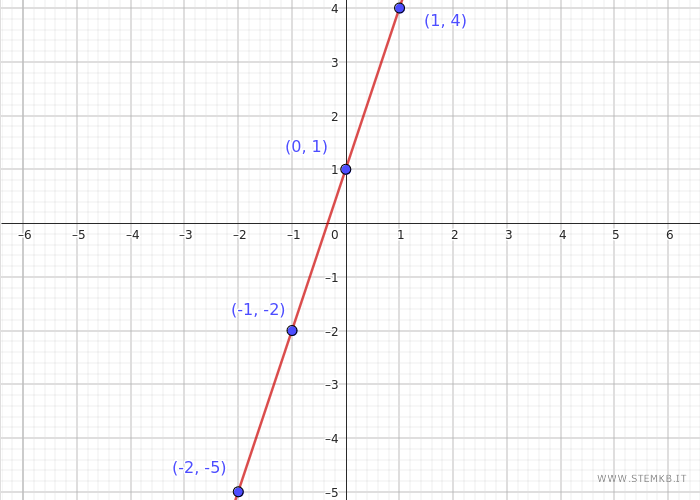
By plotting these data points on a coordinate plane, we can create the graph of the function \( f(x) = 3x + 1 \).
Let's plot these points on a Cartesian plane: \((-2, -5)\), \((-1, -2)\), \((0, 1)\), \((1, 4)\), \((2, 7)\)
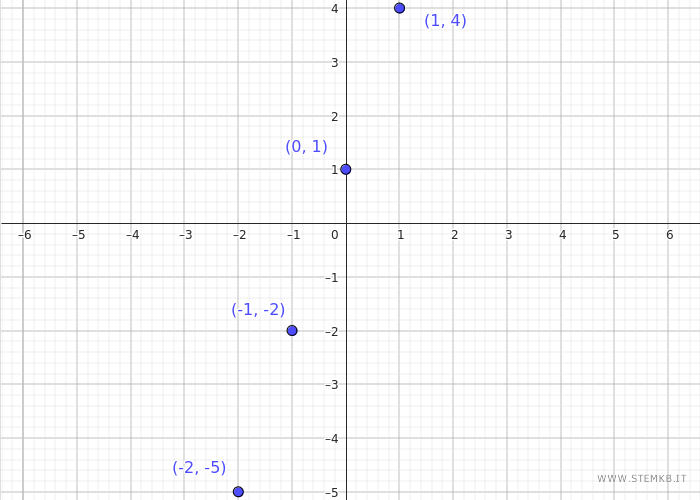
Once these points are plotted on the Cartesian plane, we can connect them with a straight line since the function \( f(x) = 3x + 1 \) is linear.
Types of Functions
Functions can be classified in various ways based on their properties. Here is an overview of the main categories:
Injective Functions
A function \( f: A \rightarrow B \) is injective if distinct elements of \( A \) are mapped to distinct elements of \( B \).
This means that each input value \( x \) produces a unique and unambiguous output value \( y \).
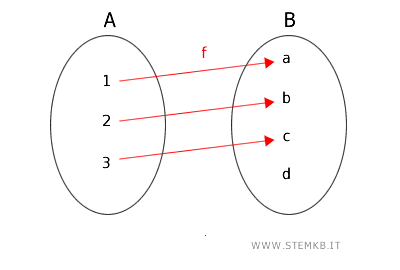
So, if the function returns the same result \( f(x_1) = f(x_2) \) for two values \( x_1 \) and \( x_2 \) from the domain, this implies that \( x_1 = x_2 \).
Surjective Functions
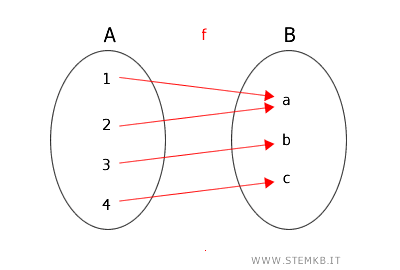
A function \( f: A \rightarrow B \) is surjective if every element of \( B \) is the image of at least one element of \( A \).
In other words, the codomain is completely covered by the function, meaning each element \( y \) in the codomain \( B \) is associated with at least one element \( x \) in the domain \( A \).
Bijective Functions
A function is bijective if it is both injective and surjective. This implies a one-to-one correspondence between the elements of the domain and those of the codomain.
Every element of \( A \) is mapped to a unique element of \( B \) and vice versa.
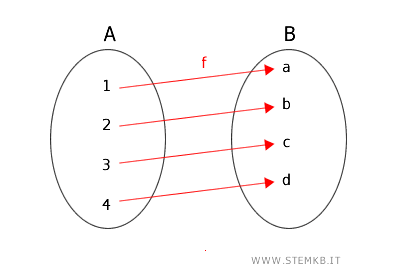
Injective, surjective, and bijective functions represent the main categories that help classify and better understand the behavior of functions in mathematical applications.


