
Resultant Force
What is the resultant force?
The resultant force is the vector sum of all the individual forces acting on an object: $$ \vec{R} = \vec{F}_1 + \vec{F}_2 $$
Unlike scalar addition, when adding vectors, both the direction and orientation of the forces must be considered.
The resultant force represents the combined effect of multiple forces acting on an object simultaneously.
This fundamental concept in physics helps us understand how forces affect the motion and equilibrium of objects.
An Example
Imagine a book resting on a table. It appears motionless, but in reality, at least two forces are acting on it.
One force \( \vec{F_1} \) is gravity, pulling the book downward, while the other force \( \vec{F_2} \) is the table’s normal force, pushing upward to counteract gravity.
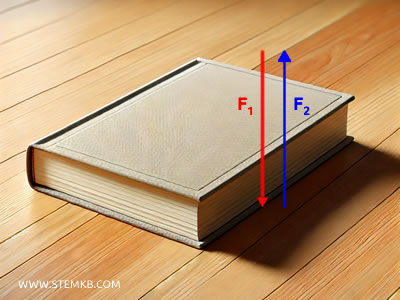
The two arrows represent the vectors of these forces, showing both their direction and orientation. The length of each arrow indicates the magnitude of the corresponding force.
To graphically determine the vector sum, we place the vectors end-to-end, as though we were “chaining them together.” The resultant vector connects the starting point of the first vector to the endpoint of the last.
Why doesn’t the book move?
Because these two forces perfectly balance each other, resulting in a vector sum of zero.
This is the essence of the resultant force. The vector sum of these forces is zero: \( \vec{F_1} + \vec{F_2} = \vec{0} \).
Here, the two vectors have equal magnitudes (lengths) but point in opposite directions. As a result, the endpoint of the last vector (blue arrow) aligns perfectly with the starting point of the first vector (red arrow).
When the resultant force is zero, the system is said to be in equilibrium. This is a special case of the resultant force, which we’ll explore in more detail in the next section.
Example 2
When an archer pulls back the bowstring and releases it, two equal but oppositely inclined forces act on the arrow.
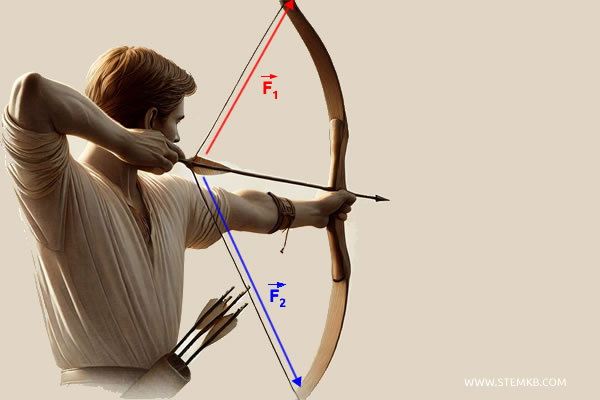
We can represent these forces with two vectors \( \vec{F}_1 \) and \( \vec{F}_2 \), both originating from the same point.
- The force from the right side of the string (vector \( \vec{F}_1 \)), inclined to the left.
- The force from the left side of the string (vector \( \vec{F}_2 \)), inclined to the right.
These two forces, symmetric and opposing, create an angle at their intersection point.
To find the resultant force, we add the two vectors using the vector addition method or the parallelogram rule.
We complete the parallelogram by drawing lines parallel to the vectors.
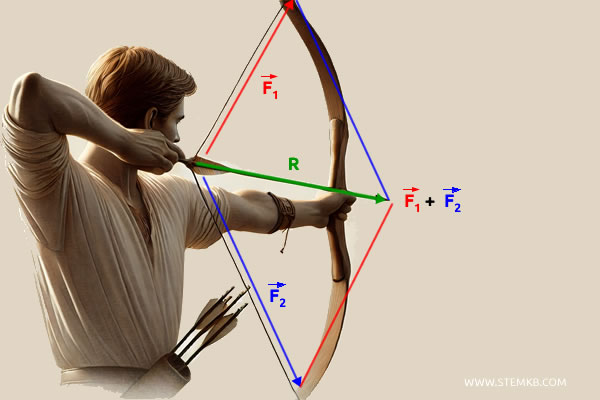
The diagonal of the parallelogram, starting from the common origin of the vectors, represents the resultant force \( \vec{R} \).
$$ \vec{R} = \vec{F_1} + \vec{F_2} $$
In this example, the resultant force \( \vec{R} \) points forward along the central axis of the bow, aligning with the arrow’s direction.
In other words, the two oblique forces \( \vec{F}_1 \) and \( \vec{F}_2 \) combine to produce a resultant force that propels the arrow forward. The horizontal components of the forces add together, while the opposing vertical components cancel each other out. The net effect is a horizontal resultant vector that drives the arrow forward.
This example clearly demonstrates how the vector sum of multiple forces determines the motion of an object.
Force Equilibrium
An interesting scenario occurs when the vector sum of all forces equals zero.
$$ \vec{R} = \vec{F_1} + \vec{F_2} = \vec{0} $$
In this case, the resultant force is zero, and the object remains in equilibrium.
This can happen even when the individual forces are not zero.
For instance, imagine two people pulling on a rope in opposite directions with equal force \( | \vec{F_1} | = | \vec{F_2} | \).
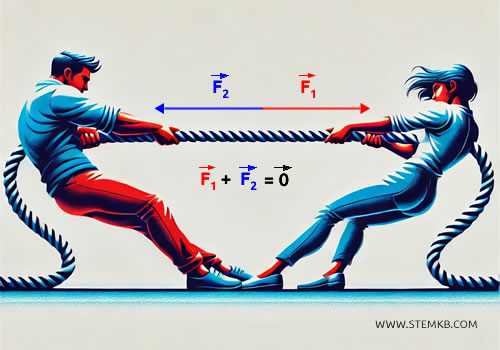
Although both individuals continue to pull, the rope doesn’t move because the two equal and opposite forces cancel each other out.
This happens because the resultant of the forces is the zero vector: \( \vec{F_1} + \vec{F_2} = \vec{0} \), putting the forces in perfect equilibrium.
If one side were to exert more force than the other, the rope would move in the direction of the stronger force. This is why understanding the resultant force allows us to describe an object’s state and predict its future behavior, unlocking countless practical applications.
Force balance is fundamental to countless real-world situations and natural phenomena.
We often overlook them because they seem “ordinary,” but force equilibrium is everywhere—from a chandelier hanging from the ceiling to a vase sitting on a table or a bridge spanning a river.
FAQ
- Can the resultant of two forces with different magnitudes be zero?
No, if the forces have different magnitudes, their vector sum cannot be zero. For the resultant to be zero, the forces must have equal magnitude, act along the same line, but point in opposite directions. - Can the resultant of three forces with different magnitudes be zero?
Yes, it is possible. For the resultant of three forces to be zero, they must balance each other perfectly, forming a closed triangle when represented graphically. This happens when the forces satisfy the condition of vector equilibrium.For example, consider these vectors $ \vec{u} $, $ \vec{v} $, and $ \vec{w} $, which represent three forces:
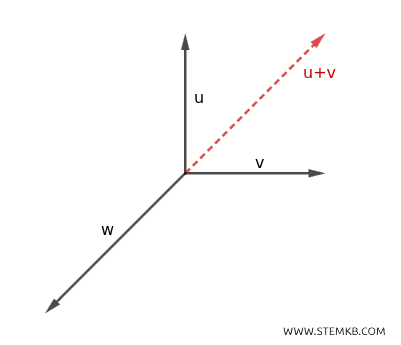
The sum of the three forces is zero: $$ \vec{u} + \vec{v} + \vec{w} = \vec{0} $$ Geometrically, this is because the sum of vectors $ \vec{u} + \vec{v} $ is equal to the vector opposite to $ \vec{w} $: $$ \vec{u} + \vec{v} = - \vec{w} $$ Adding a vector to its opposite always results in the zero vector. Therefore, the resultant of the three forces is zero: $$ ( \vec{u} + \vec{v} ) + \vec{w} = - \vec{w} + \vec{w} = \vec{0} $$


